
Benefits of Nude Yoga: Body Awareness, Confidence & Mindfulness
Benefits of Nude Yoga: Body Awareness, Confidence & Mindfulness
2026 GUIDE | UPDATED: 09/24/26
The benefits of nude yoga can extend beyond practicing yoga without clothes. For some people, removing clothing changes how they experience movement, body awareness, mindfulness, confidence, sensuality, and the simple sensation of being present in their body.
Nude yoga, also commonly called naked yoga, is the practice of yoga without clothing. The two terms generally describe the same practice, and throughout Naked Fit Club you’ll see both used depending on the context. We primarily use nude yoga, while also recognizing naked yoga as a common way people describe and search for the practice.
The poses, breathing, balance, mobility, and principles of yoga remain the same. What changes is the experience of practicing without a layer of clothing between you and your body.
For some people, that difference is subtle. For others, it can make a familiar yoga practice feel surprisingly different.
There isn’t one universal experience, and nude yoga isn’t automatically better than practicing clothed. But there are several reasons people find practicing yoga naked interesting, comfortable, challenging, freeing, sensual, or simply enjoyable.
What Are the Benefits of Nude Yoga?
Potential benefits of nude yoga include greater body awareness, fewer distractions from clothing, increased familiarity with your body, opportunities to practice body acceptance, and a different experience of mindfulness and movement.
Some people simply enjoy the physical freedom of practicing without clothes. Others find that nudity changes how they experience confidence, sensuality, self-consciousness, or physical sensation.
Many of these benefits are personal and experiential rather than outcomes unique to nude yoga. Yoga itself has been studied much more extensively than yoga practiced specifically without clothing, so it’s useful to keep that distinction in mind.
The question isn’t whether taking off your clothes suddenly transforms yoga. It’s whether practicing without them changes the experience in ways that are meaningful to you.
1. Greater Body Awareness
One of the most immediate differences in nude yoga is being able to see and feel more of your body as it moves.
Without clothing covering the torso, hips, legs, shoulders, and other areas, you may become more aware of posture, alignment, muscle engagement, breathing, balance, tension, and range of motion.
This connects with two important aspects of body awareness: proprioception, your sense of where your body is and how it is moving, and interoception, your awareness of sensations and signals arising from within your body.
Yoga already encourages this kind of attention. Practicing naked may make certain sensations or movements easier to notice simply because there is less between you and your body.
2. Freedom of Movement
Good yoga clothing is designed to move with the body, but clothing is still something you can feel.
Waistbands shift. Shirts move. Fabric stretches. Straps press against the skin. Loose clothing falls in certain poses. Tight clothing can create pressure or compression.
Practicing nude removes those sensations.
That doesn’t necessarily increase your actual range of motion, but it may create a greater sense of physical freedom. You can stretch, twist, bend, balance, and breathe without adjusting clothing or thinking about where fabric is sitting on your body.
For some people, that simplicity is one of the most enjoyable parts of nude yoga.
3. A Different Kind of Mindfulness
Yoga often asks us to bring attention back to the present moment: the breath, the position of the body, the sensation of a stretch, or the feeling of the floor beneath us.
Nudity can add another layer to that awareness.
You may notice the temperature of the room, air against your skin, the movement of your abdomen as you breathe, contact between different parts of your body, or subtle changes in muscle tension.
Those sensations don’t need to be profound. That’s partly the point.
Mindfulness can be as simple as noticing what is happening in your body without immediately needing to change or judge it.
4. Becoming More Familiar With Your Body
Many adults spend surprisingly little time simply being naked without another activity or expectation attached to it.
Nudity may happen while showering, changing clothes, having sex, or quickly moving from one outfit to another. It isn’t always something we experience neutrally.
Nude yoga creates a different context.
Your body isn’t being dressed, posed for a photograph, compared with someone else’s, or necessarily presented sexually. It’s doing something.
It’s balancing. Stretching. Breathing. Working. Resting.
That repeated experience may help some people become more familiar with their bodies as bodies rather than primarily as objects to evaluate.
5. Body Confidence and Self-Acceptance
You don’t need to feel confident naked before trying nude yoga. Curiosity about body confidence is one reason some people explore it in the first place.
Seeing your body move can be very different from standing still in front of a mirror and inspecting it. Your attention may begin shifting toward what your body is doing rather than whether every part of it meets a particular aesthetic ideal.
That doesn’t mean one naked yoga session will suddenly eliminate years of body insecurity. Body confidence is more complicated than that.
But repeated, nonjudgmental familiarity with your own body may offer another way to relate to it. Confidence can sometimes begin not with loving everything you see, but with becoming more comfortable seeing it.
For a broader look at these ideas, our article on the psychology of naked fitness explores body image, confidence, self-consciousness, mindfulness, sexuality, and the experience of being naked in greater depth.
6. Less Attention on Appearance
This might sound contradictory. If you’re completely naked, wouldn’t you pay more attention to how you look?
At first, you might.
But during an actual yoga practice, your body has a job to do. You’re thinking about balance, breathing, positioning, stability, tension, comfort, and moving from one pose to another.
That can create an opportunity to experience your body functionally rather than only visually.
Instead of asking, “How does my body look?” the more immediate questions become, “How does this feel?” and “How is my body moving?”
That shift from appearance toward experience is an important part of the Naked Fit Club approach to both nude yoga and naked fitness.
7. Comfort With Nudity
Comfort with being naked isn’t something everyone naturally has.
Our attitudes toward nudity can be shaped by family, culture, religion, relationships, sexuality, media, body image, aging, and countless personal experiences.
Practicing naked privately gives you an opportunity to explore nudity without an audience. You don’t have to perform confidence or look a certain way. Nobody else even needs to know you’re doing it.
For some people, simply spending more ordinary time naked can make nudity feel less unusual.
If you’re curious but unsure how to begin, our Nude Yoga for Beginners guide walks through getting comfortable, creating privacy, and approaching your first practice gradually.
8. Breathing Without Restrictive Clothing
Breathing is central to many forms of yoga.
Practicing without tight waistbands, sports bras, compression garments, or other fitted clothing may make the physical movement of breathing feel more noticeable or comfortable for some people.
You can observe the abdomen and rib cage expand and contract and feel the movement of the breath across more of the torso.
The benefit isn’t that nudity gives you a special way to breathe. Removing clothing may simply remove one more distraction while you pay attention to a process that is already happening.
9. Relaxation and Stress Relief
Yoga is commonly practiced as a way to slow down, move intentionally, breathe, and step away from the demands of the day.
Nude yoga can be approached in exactly the same way.
A quiet room, comfortable temperature, deliberate breathing, gentle stretching, and focused attention can create a very different experience from rushing through a workout or constantly checking your phone.
For some people, nudity adds to that sense of letting go. Clothing comes off, distractions are reduced, and the practice becomes time devoted simply to moving and being present.
The relaxation benefits shouldn’t be attributed to nudity alone. Movement, yoga, breathing, environment, expectations, and personal preference can all contribute to the experience.
10. Sensuality, Sexual Arousal and Body Awareness
Nude yoga does not have to be sexual. But practicing naked can sometimes produce feelings of sensuality or sexual arousal—and there is nothing unusual about that.
Arousal is one of many responses the human body can experience. Nudity, physical sensation, movement, relaxation, increased attention to the body, and simply feeling comfortable in your own skin can all influence how you feel.
For some people, nude yoga feels completely nonsexual. For others, it may feel sensual, pleasurable, or occasionally arousing. The same person may experience it differently from one practice to another.
Experiencing arousal doesn’t mean the entire practice has suddenly become sexual. You can simply notice the response in much the same way you might notice warmth, tension, relaxation, excitement, vulnerability, or changes in your breathing.
This can also be part of body awareness: recognizing what you’re feeling without immediately judging it or assuming every physical sensation requires a particular response.
At Naked Fit Club, we don’t believe sexuality and sensuality need to be erased from conversations about the body for naked movement to be taken seriously. They are part of the range of experiences people can have while living in and becoming more familiar with their bodies.
11. Seeing Your Body Move
If you practice with a mirror, nude yoga gives you an unobstructed view of your body in motion.
That can be useful for observing general posture and positioning, although a mirror shouldn’t be treated as a substitute for qualified instruction when learning technically demanding poses.
It can also be interesting simply to see your body doing something rather than posing.
Muscles engage. Weight shifts. The abdomen changes with breathing. Balance changes from one side to another. Bodies fold, stretch, compress, lengthen, shake, and adjust.
Seeing those things can make the body feel less static and more alive.
12. A More Personal Yoga Practice
One of the advantages of nude yoga is that it can be an entirely private experience.
You don’t need a studio, an audience, or a group of other naked people. You can practice alone at home and decide exactly how much you want to participate.
You can also simply watch. Following a nude instructor doesn’t mean you need to remove your own clothes, appear on camera, or perform every pose. Watching, learning, and exploring the practice can be the experience.
If you do want to participate, you might begin with ten minutes of stretching after a shower, follow a complete yoga practice, start clothed and remove something when you feel comfortable, or practice fully nude from the beginning.
There is no required progression.
The ability to shape the experience around your own comfort and curiosity is one of its greatest advantages.
Are the Benefits of Nude Yoga Different From Regular Yoga?
Many of the physical and psychological benefits associated with yoga come from yoga itself—not from being naked.
Practicing without clothing changes the context.
It may increase awareness of physical sensation, remove clothing-related distractions, expose more of the body’s movement, create opportunities to become more comfortable with nudity, and change the way you think about your body during the practice.
Those differences may matter a great deal to one person and very little to another.
You don’t have to choose between clothed and nude yoga either. Both can be part of the same practice.
Do You Need to Be Comfortable Naked First?
No.
You don’t have to jump directly into an entire naked yoga session—or practice naked at all.
If you want to try it, start wherever your comfort level is today. Close the blinds. Lock the door. Make sure the room is warm. Begin in underwear if that feels better. Try one or two familiar poses and see how the experience feels.
There is no prize for getting naked faster.
If you’d like more practical guidance, start with Nude Yoga for Beginners.
The Biggest Benefit May Be Paying Attention
Nude yoga doesn’t need to promise a dramatic transformation to be worthwhile.
Sometimes the value is much simpler.
You take off your clothes—or simply watch someone who has. Put down your phone. Pay attention. Breathe. Move if you want to. Notice what interests you and how your body responds.
If you practice, you may discover something about your posture, flexibility, balance, breathing, confidence, self-consciousness, sensuality, or simply what it feels like to move without clothing.
And you may decide you like it.
That curiosity—paying attention to your body rather than constantly trying to fix it—is one of the ideas at the heart of Naked Fit Club.
For a broader introduction to the practice, explore our complete Nude Yoga guide, or visit the Naked Fit Club FAQs for answers about nudity, privacy, participation, fitness, and whole-body well-being.
RECENT NUDE YOGA ARTICLES
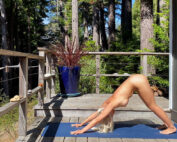
Benefits of Naked Yoga: Body Awareness, Confidence & Mindfulness
Explore the benefits of nude yoga, including body awareness, confidence, mindfulness, freedom of movement, sensuality, and relaxation.
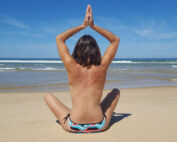
Nude Yoga for Beginners: How to Start Safely at Home
Learn how to start nude yoga at home with simple beginner poses, mindful movement, body awareness, confidence, and practical tips for your first practice.
